




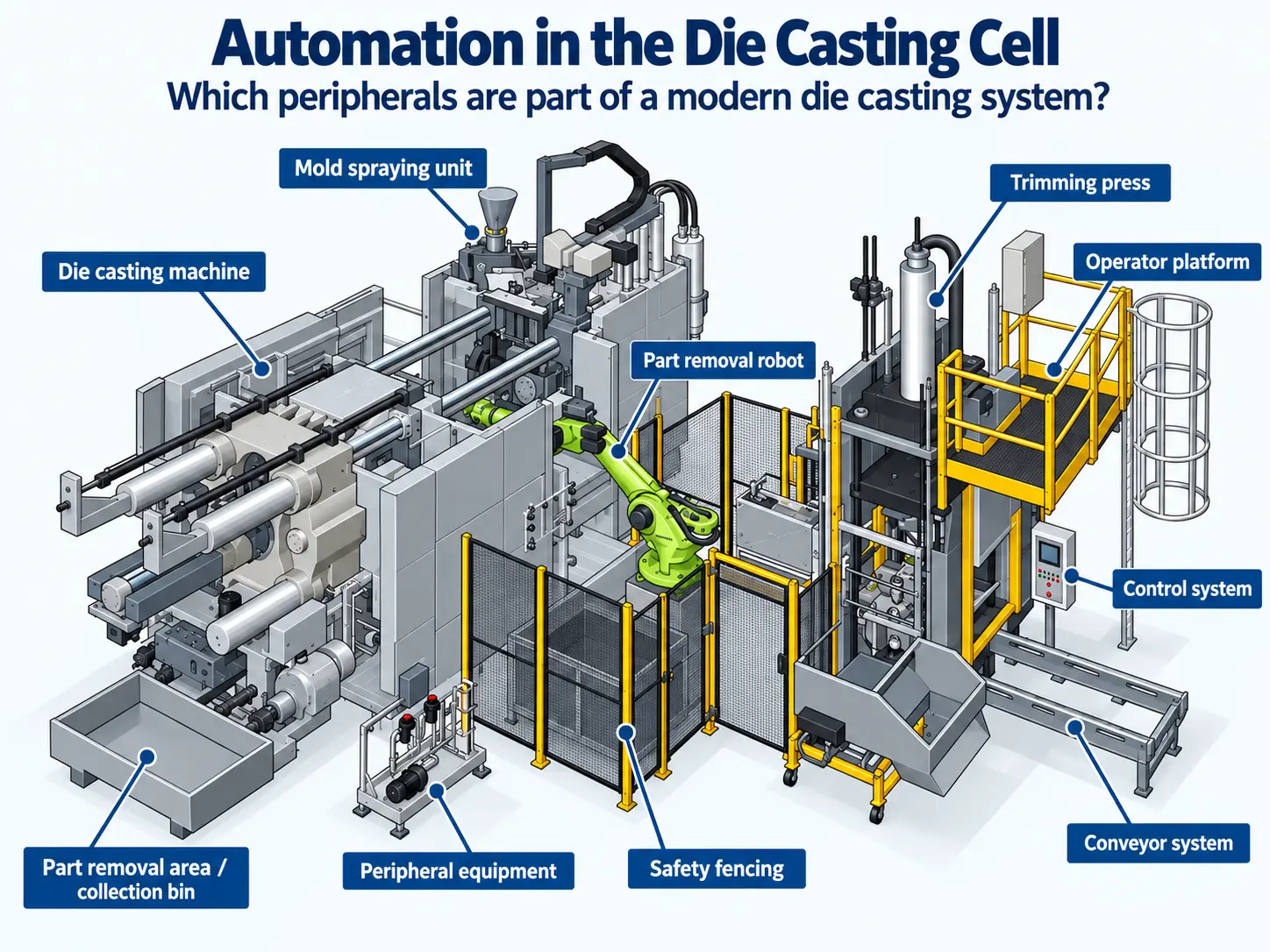
Automation in the Die Casting Cell: Which Peripheral Equipment Belongs to a Modern Die Casting System?
A modern die casting cell is much more than the die casting machine itself. Metal supply, die spraying, temperature control, part extraction, trimming, conveying and handling must work together as one coordinated production system. The objective of automation is not simply to replace manual work, but to make individual process steps more repeatable, controllable and suitable for continuous industrial production.
What Equipment Is Typically Used in an Automated Die Casting Cell?
Depending on the casting process and component, an automated die casting cell can include a dosing furnace or metal dosing system, die spraying equipment, temperature control units, an extraction robot, a trimming press, conveying systems and automated part handling.
These components are coordinated with the die casting machine through control interfaces and a defined process sequence. The exact configuration depends on alloy, machine type, die, component geometry, cycle time and quality requirements.
What Is a Die Casting Cell?
A die casting cell combines the main die casting machine with the peripheral equipment required before, during and after the actual casting process. Instead of treating each machine as an isolated unit, the cell is designed around the complete production sequence.
Before the shot, molten metal must be available and the die must be prepared at the required temperature. After casting, the component must be removed safely, separated from runners and flash, transported and, depending on the production concept, inspected or transferred to the next processing step.
The individual modules therefore have to be matched not only mechanically, but also in terms of cycle time, control signals, safety functions and material flow.

From Molten Metal to the Finished Die Cast Part
The exact sequence differs between production lines, but a highly automated cold chamber die casting cell often follows a recurring structure.
Supply and Dose the Molten Metal
The required quantity of molten metal is supplied to the die casting machine. In automated cold chamber production, this can be performed by a dosing furnace or another controlled metal dosing system.
Prepare the Die
After the previous casting has been removed, the open die can be sprayed and prepared for the next cycle. Release agent application, cooling and drying must be coordinated with the required die temperature.
Die Casting
The die closes and the casting cycle begins. The molten metal is injected into the die cavity, pressure is built up and the casting solidifies sufficiently for the die to be opened.
Extract the Casting
An extraction robot or removal device takes the casting from the open die and transfers it safely to the next station in the production sequence.
Trim and Separate
Runners, overflows and flash can be separated in a trimming press or another downstream processing system. Depending on the component, additional machining steps may follow.
Handle, Inspect and Transport
The component can then be transferred to containers, conveyors, inspection equipment or subsequent production processes. The degree of automation depends on the production concept.
The Main Automation Modules in a Die Casting Cell
Not every die casting cell requires the same peripheral equipment. Nevertheless, several modules are typical in industrial die casting production.
Dosing Furnace
Supplies a defined quantity of molten metal to the shot chamber. Repeatable dosing supports stable shot conditions and consistent production cycles.
Spraying Unit
Applies release agent and supports controlled die cooling. Spray pattern, quantity, air blow-off and cycle time must be matched to the die and process.
Temperature Control Unit
Controls selected die circuits using heating and cooling media. Stable thermal conditions contribute to reproducible casting conditions and part quality.
Extraction Robot
Removes the casting from the die and transfers it to the next process station. Robots can also perform additional handling tasks when the cell layout allows it.
Trimming Press
Separates runners, overflows and flash from the casting. The trimming tool must match the component and casting system.
Conveying and Part Handling
Conveyors, transfer units and containers move castings, scrap and finished parts between stations and out of the cell.
What Are the Advantages of an Automated Die Casting Cell?
Automation should not be evaluated only by the number of robots installed. Its main value lies in controlling repeated operations and coordinating them with the casting machine.
| Objective | Contribution of Automation | Important Condition |
|---|---|---|
| Process repeatability | Dosing, spraying, extraction and handling can be executed using defined sequences and parameters. | Equipment condition and process settings must remain stable. |
| Consistent cycle | Automated modules can reduce variations caused by manual intervention. | The slowest process step still determines the achievable overall cell cycle. |
| Operator safety | Robots and automated handling can reduce the need for personnel to enter high-temperature and moving-machine areas. | Guarding, interlocks and the overall safety concept must be correctly designed. |
| Quality control | Process monitoring and automated handling can improve repeatability and support defined inspection sequences. | Automation does not replace correct process design and quality assessment. |
| Material flow | Components and scrap can be transferred between production stations in a defined sequence. | Buffers and handling capacity must match the production rate. |
The Interfaces Between the Machines Are Just as Important as the Machines
A collection of individually functioning machines does not automatically form a functioning automated die casting cell. The equipment must exchange signals and follow a defined sequence.
For example, the die casting machine must know when the spraying unit has left the die area, when the robot is in a safe position and when metal dosing has been completed. In the same way, peripheral equipment must receive information about machine status, die position and the current process step.
- machine-ready and cycle-start signals
- die open and die closed status
- robot and spraying-unit safety positions
- dosing complete signal
- part detected or part removed signals
- fault and alarm handling
- emergency-stop and safety circuits
- interfaces to process monitoring systems
- data exchange with higher-level production systems where required
Does Automation Differ Between Cold Chamber and Hot Chamber Die Casting?
Cold Chamber Die Casting
Cold chamber machines require the molten metal to be transferred into the shot chamber for each casting cycle. Automated metal dosing therefore plays an especially important role in many aluminium die casting cells.
Larger cold chamber cells frequently combine the machine with dosing equipment, spraying systems, robots, temperature control, trimming presses and additional downstream equipment.
Hot Chamber Die Casting
In a hot chamber machine, the shot unit is directly connected to the molten metal. A separate metal dosing step comparable to a typical cold chamber aluminium cell is therefore not required.
Spraying, extraction, temperature control, conveying and other automation can nevertheless remain important depending on the component and production process.
For more information about the two machine concepts, see Cold Chamber or Hot Chamber? Which Die Casting Machine Is Right for Your Application?
How Should Peripheral Equipment Be Selected?
Peripheral equipment should not be selected independently from the die casting machine. The starting point is always the intended casting process and the component to be produced.
Define the Casting Process
Alloy, cold or hot chamber process, casting weight, die concept and production volume determine the basic requirements of the cell.
Define the Required Cycle
Dosing, spraying, extraction, cooling, trimming and transport must be capable of operating within the required production sequence.
Check Mechanical Compatibility
Robot reach, payload, installation space, transfer heights, die access, press dimensions and conveyor layout must fit the actual production environment.
Check Controls and Interfaces
Signals, communication, safety technology and software must allow all components to operate together reliably.
Evaluate the Complete Cell
The final assessment should include not only technical compatibility but also maintenance, spare parts, documentation, energy supply, floor space and commissioning requirements.
Complete Used Cell or Individual Machines?
A complete used die casting cell can be attractive because the main machine and peripheral equipment have already operated together in a production environment. This can reduce part of the engineering effort compared with sourcing every module separately.
However, this advantage only applies if the existing configuration fits the new production task. A previously coordinated cell may still require modifications when the die, casting weight, automation sequence or local infrastructure changes.
| Option | Potential Advantage | What Must Be Checked |
|---|---|---|
| Complete used cell | Main machine and peripheral equipment have already been combined in one production system. | Suitability for the new component, condition, interfaces, documentation and required modifications. |
| Existing machine + used automation | Existing production equipment can potentially be expanded without replacing the complete cell. | Mechanical integration, control interfaces, cycle time and safety concept. |
| Individual components | The cell can be configured specifically around the intended process. | Higher integration and engineering effort may be required. |
FISS offers used die casting machines as well as automation and peripheral equipment for cold chamber die casting .
What Should Be Checked Before Buying a Used Die Casting Cell?
- manufacturer, model and year of the main machine
- clamping force and shot-unit configuration
- complete list of peripheral equipment
- robot model, payload and working range
- spraying-unit configuration and axis movements
- dosing system and compatible alloy
- temperature-control units and available heating/cooling capacity
- trimming press and existing trimming tooling
- conveyor and material-flow layout
- control systems and communication interfaces
- safety devices, guarding and emergency-stop concept
- electrical and media requirements
- maintenance history and technical condition
- available manuals, drawings and software backups
- availability of spare parts and technical support
- dismantling, transport and recommissioning requirements
The Die Casting Machine Is Only the Center of the Production Cell
An automated die casting cell combines casting, metal supply, thermal management, die preparation, part extraction, downstream processing and material handling into one coordinated production sequence.
The key to successful automation is therefore not the number of individual machines, but how well those machines match the component, die casting process and each other.
When evaluating a new or used cell, the complete system should be considered: machine technology, peripheral equipment, interfaces, cycle times, safety, documentation and the requirements of the future production process.
Questions About Automation in Die Casting Cells
What Is an Automated Die Casting Cell?
An automated die casting cell combines the die casting machine with peripheral equipment such as metal dosing, spraying, temperature control, robotic extraction, trimming and material handling in a coordinated production process.
Which Peripheral Equipment Is Most Important?
There is no single configuration that fits every process. Typical equipment includes dosing systems, spraying units, temperature control units, extraction robots, trimming presses and conveying systems. The required equipment depends on the component and casting process.
Why Is a Spraying Unit Used in Die Casting?
A spraying unit applies release agent and can support controlled cooling of the die surface between casting cycles. Spray pattern, quantity, blow-off and cycle time must be matched to the die and process.
What Does an Extraction Robot Do?
The extraction robot removes the casting from the open die and transfers it to the next station. Depending on the cell, the robot can also perform additional handling tasks.
Why Are Temperature Control Units Important?
Temperature control units regulate selected die circuits and help maintain defined thermal conditions. Stable die temperatures are an important factor for reproducible casting processes.
Does Automation Always Reduce Cycle Time?
No. Automation can make process steps more repeatable and reduce manual variation, but the achievable cycle time is determined by the complete process, including solidification, spraying, extraction, trimming and material handling.
What Is the Advantage of Buying a Complete Used Die Casting Cell?
A complete used cell may reduce integration effort because the main machine and peripheral equipment have already operated together. Nevertheless, technical compatibility with the new component, die and production environment must still be checked.
Can Existing Automation Be Combined with Another Die Casting Machine?
Potentially yes, but mechanical installation, robot reach, cycle time, control interfaces, safety systems and communication between all components must be checked before integration.
FISS Helps Match the Main Machine and Peripheral Equipment.
Whether you are looking for an individual die casting machine, automation equipment or a complete used production cell, the technical configuration should match the intended component and production process. FISS can support the search for suitable used machines, peripheral equipment and complete die casting cells.
Source
Bührig-Polaczek, A.; Michaeli, W.; Spur, G. (eds.): Handbuch Urformen, Carl Hanser Verlag, sections on dosing technology, die casting and casting post-processing; supplemented by FISS practical experience with used die casting machines, cells and peripheral equipment.
