




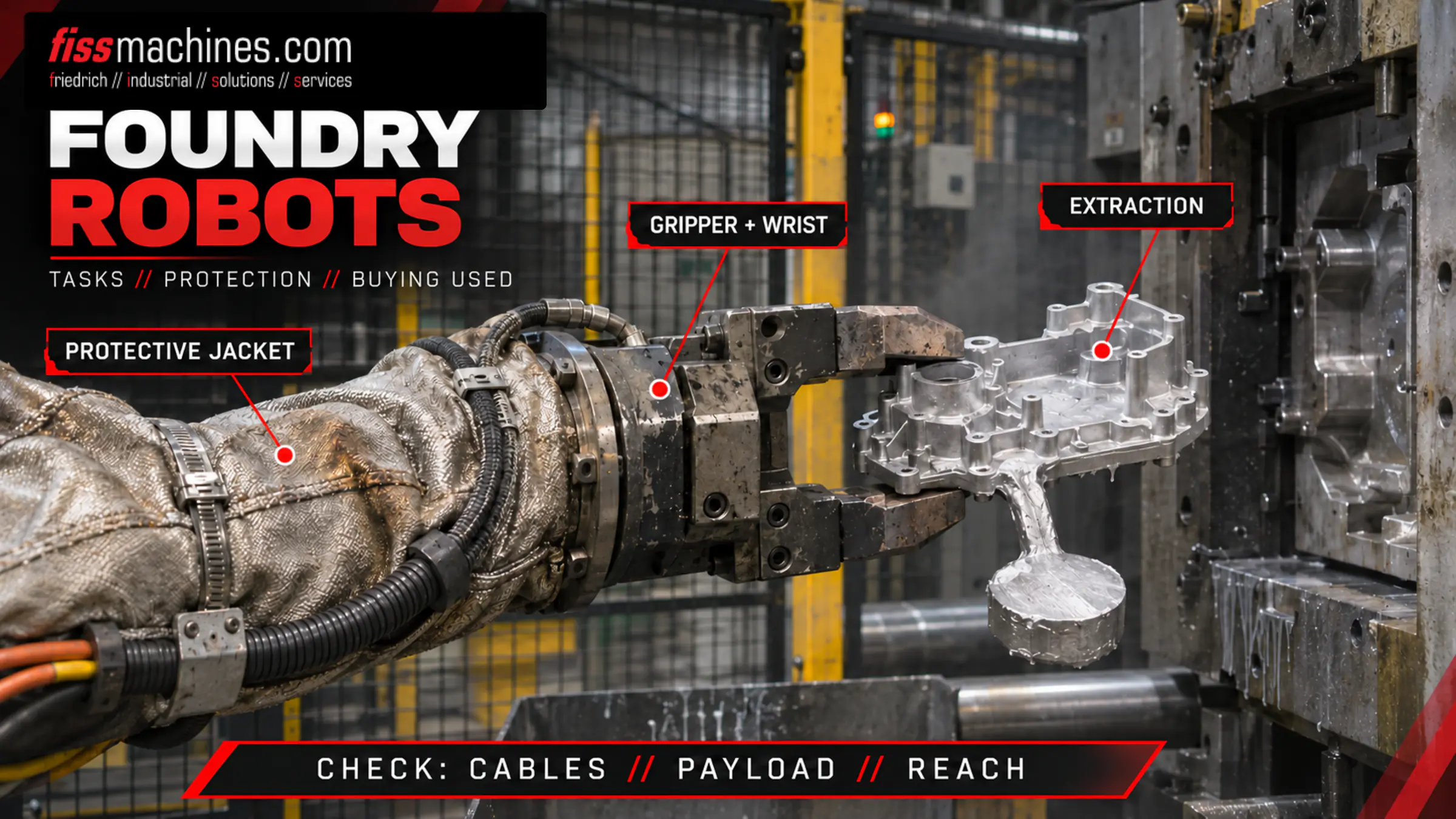
Foundry Robots in Die Casting Cells: Tasks, Protection and Buying Used
In a die casting cell the robot works next to liquid metal, release agent mist, hot castings and high-pressure cleaning. Whether it survives this environment for years depends on protection, sizing and condition.
What Is a Foundry Robot?
A foundry robot is an industrial robot in a version sealed and coated for casting environments: higher IP protection of motors and wrist, corrosion- and heat-resistant surfaces, protected cabling and often an additional protective jacket. In die casting cells it extracts castings, ladles metal, sprays the die or loads inserts and trimming presses.
For a used foundry robot, protection condition, real payload at the flange, controller generation and documentation matter more than the year of manufacture.
Which Tasks Does a Foundry Robot Perform in a Die Casting Cell?
All cell modules are covered in Automation in the Die Casting Cell. For the robot itself, each task places a different load on payload, reach, protection and cycle time.
| Task | What the Robot Does | Selection Focus |
|---|---|---|
| Extraction | Grips the casting with biscuit and runner in the open die, checks completeness, transfers it | Payload incl. gripper, reach between tie bars, wrist heat exposure |
| Ladling | Takes metal from the holding furnace and pours it into the shot sleeve | Smooth path control, splash protection, cell-level risk assessment |
| Spraying | Guides the spray tool through the open die and blows off residues | Path repeatability, release agent resistance, cleaning |
| Insert loading | Places inserts or cast-in parts into the die before closing | Positioning accuracy, part presence checks |
| Trimming press loading | Places the hot casting into the trimming die and removes it | Transfer height, interlocks with the press, cycle balance |
Spray paths are discussed in Die Spraying in Die Casting, the press side in Trimming in Die Casting. If one robot combines extraction, quenching and press loading, the slowest step sets the cell cycle.
What Does Foundry Protection Mean – and What Does IP67 Cover?
The IP code according to IEC 60529 rates protection against solids (first digit) and water (second digit); IP67 means dust-tight and protected against temporary immersion. An IP67 robot is therefore sealed – but IP67 says nothing about heat, metal splashes or chemical attack. Manufacturers address these with additional packages:
Foundry Plus 2
Optional package that makes “your entire robot IP67 compliant, from base to wrist”, with two-component epoxy paint, nickel-coated tool flange and resistance to high-pressure steam washing; leather cable guard as option (manufacturer statement, brochure 2010).
Foundry Variants
KUKA states IP67 as standard for the entire machine on its KR QUANTEC foundry variants and a wrist that withstands 180 °C for ten seconds per minute; Viton seals and sealing air at the wrist (manufacturer statements).
Robot Protective Jacket
Yaskawa offers high-durability robot jackets in several materials that “can be cooled if needed” (manufacturer statement). A jacket shields against splashes and radiant heat.
A robot sold as “foundry version” should be identified by the exact model code and protection option in the manufacturer documentation. A standard robot with a retrofitted robot protective jacket is not the same as a factory-sealed foundry variant.
How Are Payload and Reach of an Extraction Robot Sized?
Catalogue payload applies to a defined load point near the flange. In practice, the extraction robot carries gripper, adapter, sensors and the casting with biscuit, runner and overflows – often far ahead of the flange. KUKA’s load evaluation service, for example, asks for mass, centre of mass and inertias and checks against the payload diagram and static and dynamic load graphs whether the robot is overloaded (manufacturer statement).
Reach depends on die opening stroke, tie bar spacing, ejector side and the position of quench tank and press. KUKA states payloads of 16 to 270 kg and reaches up to 3,900 mm for its shelf-mounted foundry robots designed for die casting machines (manufacturer statement). Shelf mounting saves floor space but needs a stiff base.
Controller Generations and Spare Parts Availability
With a used industrial robot, the controller often limits remaining life more than the mechanics. ABB, for example, announced in 2024 that OmniCore replaces the IRC5 controller, whose phase-out ABB scheduled for June 2026, and that it will continue to support customers with spare parts and services (as reported by The Robot Report). KUKA currently presents the KR C5 on its controller page, while many used KUKA robots still run on the KR C4.
- Ask which lifecycle phase the manufacturer assigns to the controller and drive generation.
- Check availability of teach pendant, drive units, I/O and fieldbus boards and the battery packs.
- Clarify whether the robot arm can be operated with the current controller generation if an upgrade becomes necessary.
Repair and obsolescence strategies for control electronics are described in Electronic Spare Parts for Older Foundry Machines.
What Should Be Checked on a Used Foundry Robot?
A foundry robot used in multi-shift die casting shows wear in typical places. Check during an inspection under power:
- Operating hours: controller log or service records, compared with the stated history
- Gear backlash: play on each axis with the brakes applied, noise and vibration during slow and fast moves
- Leaks and grease: oil traces at gearbox seals, records of oil and grease changes
- Cables and dress pack: abrasion, burn marks and brittle insulation on motor, signal and media lines
- Batteries and mastering: state of the position memory batteries; after a battery change, ABB manuals require the revolution counters to be updated, so ask whether calibration data exist
- Software options: licensed options, fieldbus, safety functions and a complete backup of programs and configuration
- Documentation: model code with protection option, manuals, circuit diagrams, declaration of incorporation
- Protection condition: paint, seals, wrist covers and jacket without cracks or metal deposits
Integration and Safety of a Robot in the Die Casting Cell
ISO 10218-1:2025 treats the industrial robot as partly completed machinery; integration into applications and robot cells is covered by ISO 10218-2:2025. The safe system is therefore the complete cell with guarding, interlocks, operating modes and the handshake with die casting machine, sprayer and press. A robot for die casting from another cell needs new signal mapping, paths and risk assessment.
Used Foundry Robot: A Decision Sequence
Define the Task
Extraction, ladling, spraying or combined handling – including quenching and press loading.
Calculate the Real Load
Gripper plus casting, centre of gravity and inertia in the manufacturer’s load diagram.
Check Layout and Reach
Die opening, tie bars, mounting, transfer heights.
Verify Protection and Controller
Foundry option by model code, controller generation, spare parts and software options.
Inspect and Plan Integration
Inspection under power, backups, documents and the new cell’s safety concept.
FISS lists used robots from several manufacturers in its foundry robot category; ABB equipment is also shown on the ABB manufacturer page.
Protection, Load Data and Controller Decide the Value
A used foundry robot can be a sound investment for a die casting cell if the protection variant matches the environment, the real load at the flange lies inside the load diagram and the controller generation is still supported. Checking these three points before purchase avoids most integration surprises.
Questions About Foundry Robots
Is an IP67 Robot Automatically a Foundry Robot?
No. IP67 rates protection against dust and water only. A foundry robot additionally needs heat- and corrosion-resistant surfaces, protected cabling and, depending on the task, a protective jacket.
Can a Standard Robot Be Converted for Die Casting?
A protective jacket and cable guards can improve a standard robot, but they do not replace factory sealing of motors and gearboxes. Whether that is sufficient should be clarified with the manufacturer or integrator.
Why Is Rated Payload Not Enough for Sizing?
The rated payload refers to a defined load point near the flange. Gripper weight, casting, centre of gravity offset and inertia must be checked together in the manufacturer’s load diagram.
What Happens When the Robot Batteries Are Empty?
The robot can lose its stored axis positions. After a battery change, manufacturers such as ABB require the revolution counters to be updated, and in some cases the robot must be recalibrated.
Find Used Foundry Robots with FISS.
FISS lists used foundry robots and die casting automation. Tell us the task, load and machine, and we will check which robot fits.
Sources
ABB Robotics: Foundry Plus 2 – Foundry robot protection, ROB0180 EN_C, November 2010, accessed 19 November 2026.
KUKA: Foundry robots, product page; press release New KR QUANTEC foundry, January 2020, accessed 19 November 2026.
KUKA: KUKA.Load and Robot controllers, product pages, accessed 19 November 2026.
Yaskawa Motoman: Die Casting, application page, accessed 19 November 2026.
The Robot Report: ABB releases OmniCore platform for control across its robotics line, 4 June 2024, accessed 19 November 2026.
ABB: IRB 2600 product manual, section on replacing the SMB battery (via ManualsLib), accessed 19 November 2026.
ISO 10218-1:2025 and ISO 10218-2:2025 – Robotics – Safety requirements, Parts 1 and 2 (catalogue and scope summary), accessed 19 November 2026.
