




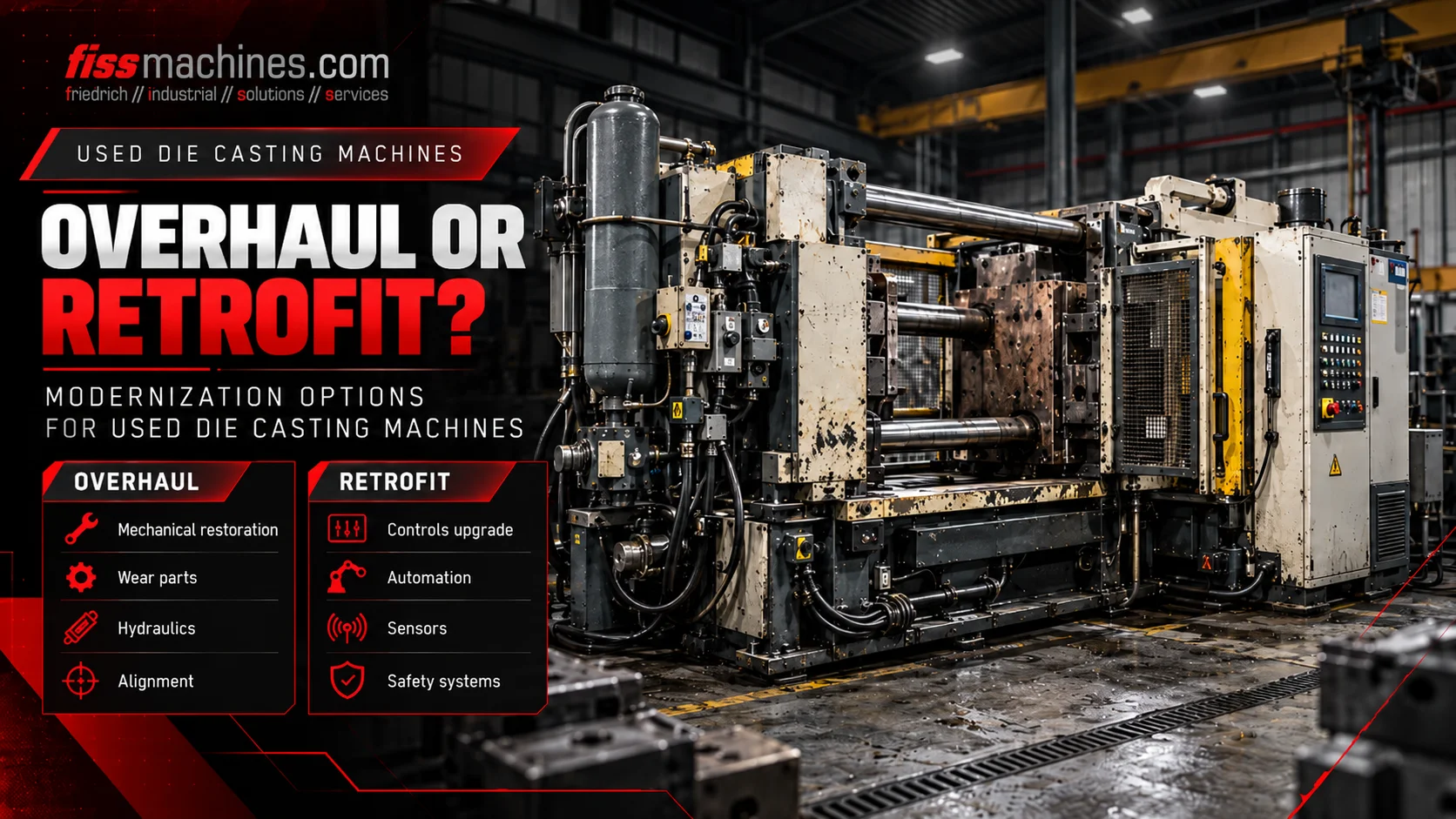
Overhaul or Retrofit? Modernising Used Foundry Machines
A used die casting machine or furnace often has a robust structure that can run for many more years. What limits it is usually something else: worn hydraulics, an obsolete control for which spare parts are hard to find, or a safety concept that no longer matches current expectations. "Overhaul" and "retrofit" are often used as if they meant the same thing. They do not, and confusing them leads to wrong budgets and wrong expectations.
What Is the Difference Between Overhaul and Retrofit?
An overhaul restores the machine's mechanical, hydraulic and electrical condition, largely within its original design: seals, cylinders, pumps, valves, guides and wear parts are inspected, repaired or replaced. A retrofit changes the design, typically by replacing the control, drives, sensors or shot control with current technology.
Both have to be followed by a safety review. Whether a modified machine meets the requirements at its place of use is not automatic; it depends on the scope of the changes and has to be assessed and documented.
What an Overhaul Covers
An overhaul starts with a structured inspection and ends with a function test. In between, the scope can range from replacing a few seals to dismantling the machine completely. Terms such as "partial overhaul" and "full overhaul" are not standardised, so the actual list of work matters more than the label.
Typical scope on a die casting machine
- Hydraulic cylinders resealed, rods and bores checked
- Pumps, valves and filters inspected or replaced, oil changed
- Accumulators inspected according to applicable rules
- Platen parallelism, tie bars and guides measured
- Toggle bushings and pins checked on toggle machines
- Shot cylinder, shot sleeve mounting and coupling inspected
- Cooling, lubrication and electrical wiring checked
An overhaul is the right approach when the structure is sound and the existing control still works reliably and can be supported with spare parts. It preserves the machine's known behaviour and documentation.
When a Retrofit Makes Sense
Controls age faster than steel. A machine may be mechanically fit, but its control can no longer be repaired economically, or it cannot provide the data and interfaces a modern cell expects. A retrofit then replaces selected systems with current components.
New PLC and operator panel with current software and documentation.
Valves, sensors and recording for a more repeatable shot and usable shot curves.
Pump drives or motor control updated where the hydraulic design allows it.
Signals for robots, sprayers, presses and data collection.
Retrofits are projects, not repairs. They need a specification, software engineering, commissioning and new documentation, and they change how operators and maintenance staff work with the machine. How peripheral units connect in a cell is described in our article on automation in the die casting cell.
Safety Revalidation: Not Automatic
Every overhaul and especially every retrofit touches safety-related functions: guards, interlocks, emergency stop, two-hand controls, and the behaviour of hydraulics when energy is removed. After the work, these functions have to be checked and the result documented.
Beyond testing, the scope of a modification can have legal consequences. In the European Union, a modification that was not foreseen by the original manufacturer and that affects safety, by creating a new hazard or increasing an existing risk, may be considered substantial. Whoever carries it out can then take on manufacturer obligations, including risk assessment and conformity documentation. The EU Machinery Regulation (EU) 2023/1230, which applies from January 2027, explicitly addresses such substantial modifications. Whether a specific project is affected has to be assessed case by case; operator obligations under national workplace safety rules apply in any case.
Neither an overhaul nor a retrofit makes a machine compliant by itself. Plan the safety review as part of the project from the start, with qualified people and clear responsibilities between supplier and operator.
Overhaul, Retrofit and Safety Review Compared
| Aspect | Rénovation mécanique | Rétrofit de contrôle | Revue de sécurité |
|---|---|---|---|
| Goal | Restaurer l'état et la fiabilité | Remplacer les systèmes obsolètes, ajouter des fonctions | Confirmer le fonctionnement en toute sécurité et le documenter |
| Design change | En grande partie aucun | Oui, dans les systèmes modifiés | Éventuellement, si des mesures sont requises |
| Main risks | Domages cachés découverts lors du démontage | Portée, logiciel, temps de mise en service | Découverte tardive des mesures manquantes |
| Documentation | Rapports d'inspection et de travaux | Nouveaux schémas électriques, logiciel, manuels | Évaluation des risques, enregistrements de tests |
| Typical trigger | Usure, fuites, procédé instable | Pénurie de pièces détachées, besoins en données | Toute modification, relocalisation, nouveau site |
Comment décider : Cinq questions
La structure est-elle solide ?
Des fissures dans les plateaux ou le châssis, des guides fortement usés ou des barres de liaison endommagées peuvent remettre en question l’investissement futur.
Le contrôle peut-il encore être supporté ?
Vérifier la disponibilité des pièces de rechange, les sauvegardes logicielles et les personnes qui peuvent l’entretenir.
Que demande le processus ?
Les pièces avec des exigences de haute qualité peuvent nécessiter un meilleur contrôle des tirs ou un enregistrement des données que la machine d’origine offre.
Que nécessite la revue de sécurité ?
Clarifier dès le départ quelles mesures sont nécessaires sur le lieu d’utilisation et qui en est responsable.
Comment comparer les coûts et les temps d’arrêt ?
Comparer l’ensemble du projet, y compris la mise en service et la formation, avec des alternatives telles qu’une autre machine d’occasion.
L’inspection d’une machine avant l’achat est une étape distincte. Les questions ci-dessus concernent ce qui se passe une fois la machine sur site ou déjà en production, et ce qu’elle nécessite réellement.
Questions fréquemment posées
Une machine rénovée fonctionne-t-elle comme une neuve ?
Pas nécessairement. Une rénovation restaure l’état défini dans son champ d’application. Les limites de conception, les fonctions de contrôle et les caractéristiques de la machine d’origine restent tels quels, sauf modification.
Rénovation et rétrofit peuvent-ils être combinés ?
Oui, et c’est courant. Les combiner évite un démontage deux fois, mais la portée et la revue de sécurité doivent être planifiées ensemble.
Un rétrofit est-il toujours meilleur que de garder le contrôle ancien ?
Non. Un contrôle fonctionnel, bien documenté et avec des pièces de rechange disponibles peut être le choix le plus économique. Un rétrofit est rentable lorsque l’obsolescence, les besoins du procédé ou l’intégration le rendent nécessaire.
Une machine relocalisée nécessite-t-elle une nouvelle revue de sécurité ?
Une revue sur le nouveau site est conseillée dans tous les cas, car l’environnement, les équipements connectés et les règles applicables peuvent différer.
FISS prend en charge les projets de rénovation et la sélection des machines.
Discutez avec FISS de l’état de votre machine et de l’étendue envisagée, ou des machines d’occasion qui pourraient être rénovées pour répondre à vos exigences.
